عن ماذا تبحث?
Choose an aluminized fiberglass heat shield when the complete construction meets the required temperature, fit and durability targets. Consider a silica-based barrier when the textile substrate needs greater thermal capability. Do not upgrade the substrate alone and assume that the reflective facing, lamination bond or mounting adhesive has gained the same capability.
That distinction is central to a useful fiberglass vs silica heat shield comparison. A barrier may remain attached but lose its reflective facing, or the textile may remain intact while the adhesive releases from the panel. The material change should address the part of the assembly that limits performance.
BSTFLEX supplies both constructions within its reflective heat barrier materials range. This guide focuses on selecting the substrate for flexible panel barriers, rather than comparing exhaust wraps or rigid metal shields.
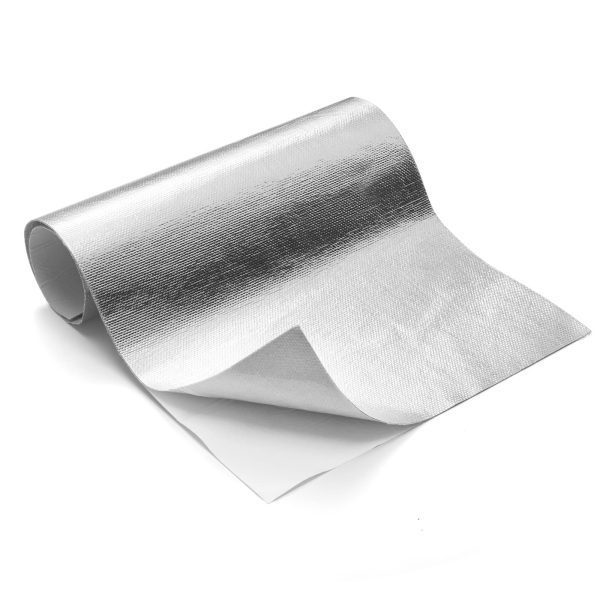
In an aluminized barrier, the exposed facing interacts with radiant heat, while the textile supports the facing and contributes to the thermal and mechanical behavior of the laminate. Changing fiberglass to silica changes the substrate. It does not, by itself, establish a higher reflectance or a lower temperature behind the finished part.
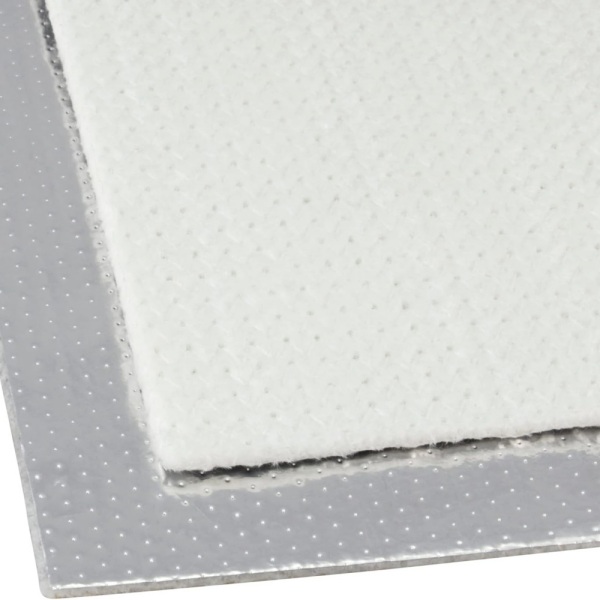
The BSTFLEX aluminized fiberglass heat shield barrier mat provides a glass-fiber-based construction. The aluminum silica thermal barrier mat uses woven silica. Request the facing, textile construction, finished thickness and attachment specification for the exact version being quoted.
Fiberglass describes a family of materials, not one universal temperature grade. Likewise, a silica product needs a defined fabric specification. Compare the identified candidates, not an unspecified fiberglass sample against an unspecified high-temperature cloth.
Silica versus fiberglass is one decision. Adhesive versus mechanical retention is another. Keep them separate so that a material comparison does not accidentally become a comparison of two different mounting systems.
| Selection route | BSTFLEX starting product | What the inquiry must define |
|---|---|---|
| Fiberglass substrate; attachment specified separately | Aluminized fiberglass heat shield barrier mat | Facing, textile, thickness and the supplied backing. State the intended fixing method rather than inferring it from the product name. |
| Silica substrate; attachment specified separately | Aluminum silica thermal barrier mat | Woven silica construction, laminate requirements and support or bonding arrangement. |
| Fiberglass substrate with supplied adhesive backing | Adhesive-backed aluminum fiberglass heat shield mat | Mounting-surface compatibility, adhesive-interface temperature and the complete thermal cycle. |
| Silica substrate with supplied adhesive backing | Adhesive-backed aluminum silica heat shield barrier | The same bonding requirements, assessed for the actual silica laminate and quoted adhesive. |
The four routes are not interchangeable specifications. An adhesive-backed silica barrier is not simply a fiberglass adhesive mat with every temperature limit increased. Confirm the construction and its applicable data before approving a substitution.
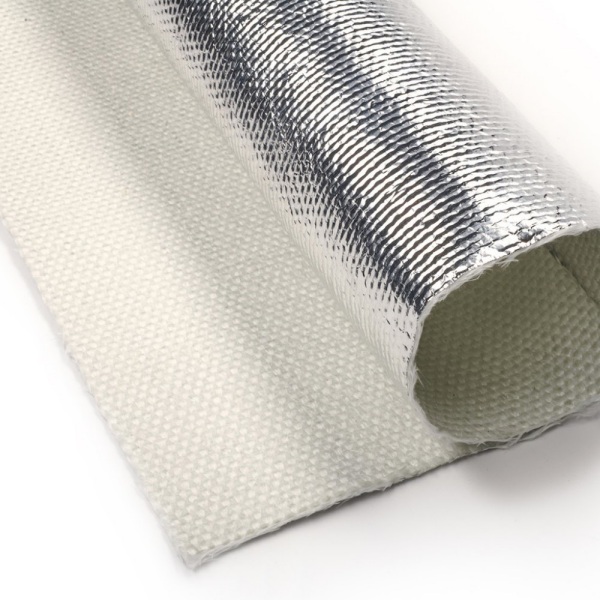
Keep fiberglass in the evaluation when it can satisfy the application requirements without a substrate change. The important evidence is the receiving-panel temperature, the condition of the laminate and the stability of its mounting after the required service exposure.
For example, a body panel shielded from a nearby exhaust may already meet its temperature target with an aluminum-faced fiberglass construction. If the fabric, facing and attachment also pass the agreed durability checks, a higher-temperature substrate is not automatically a necessary improvement.
Compare finished-part quotations rather than assuming a price difference from the fiber name. Thickness, backing, usable sheet dimensions, cutting yield and order quantity can change the purchasing result. An acceptable fiberglass construction should not be rejected solely because another material advertises a larger maximum temperature.
Silica fabrics are candidates for more demanding textile-temperature exposure than conventional fiberglass constructions. A silica trial is particularly relevant when evaluation shows that the existing textile loses the strength, shape or integrity needed for continued service, and thermal exposure is identified as the cause.
That is different from finding an adhesive edge lifting or a reflective face rubbing against a bracket. Establish the failure mechanism first. A different substrate may still need a different facing, interlayer bond, fixing system or installed geometry.
Specify what the silica candidate must retain after exposure. Depending on the part, this may be coverage around a cutout, integrity at a fastening point or sufficient flexibility for scheduled removal. A sample that looks intact immediately after heating has not necessarily demonstrated all of these requirements.
Use the observed condition to decide what should change. The following checks are a selection framework, not a claim that any particular failure has been diagnosed from appearance alone.
| Observed condition | First investigation | Does silica alone resolve it? |
|---|---|---|
| The textile cracks or loses required strength after exposure. | Confirm actual substrate exposure, duration and whether mechanical damage contributed. | It may justify testing a silica substrate, with the complete laminate requalified. |
| The reflective facing separates from an intact fabric. | Review the facing-to-fabric bond, thermal cycling and flexing. | Not necessarily. The lamination system may be the limiting element. |
| The entire barrier lifts from the panel. | Check the receiving surface, mounting adhesive, edge loading and interface temperature. | Not necessarily. Changing fiber does not qualify the adhesive. |
| The protected component remains too hot while the shield looks intact. | Check coverage, clearance, heat paths, thickness and measurement conditions. | Not necessarily. Temperature survival and useful thermal protection are different outcomes. |
| A hole tears or the edge wears through. | Inspect attachment loads, support, contact and vibration. | Not automatically. The pattern or retention detail may need revision. |
A hot-source temperature, a material temperature and a protected-panel temperature answer different questions. Do not compare a radiant-exposure rating for one product with a direct-contact rating for another as though they were the same test.
Radiant exposure: ask how the source, separation, exposure duration and airflow were defined. A material can face a very hot source without every layer reaching that source temperature.
Substrate exposure: identify whether the figure applies to the raw fabric or the finished laminate, and whether it describes continuous service or a brief event. Request the acceptance condition after exposure, not just the highest temperature reached.
Adhesive-interface temperature: establish the conditions where the barrier meets the receiving surface. This limit must be checked independently of the textile capability.
Protected-side performance: define the maximum acceptable temperature at the component or panel being protected. A barrier that survives the exposure can still fail this requirement.
Neither substrate name authorizes direct installation on a turbocharger housing or exhaust pipe. The panel barriers discussed here need an installation assessed for their complete construction; they should not be reclassified as direct-contact exhaust insulation from a fiber rating alone.
A woven silica laminate and a thicker fiberglass mat can differ in more than their fiber chemistry. Thickness, textile structure, facing and compression all need to be recorded. The higher-temperature fabric is not automatically the construction that produces the lowest receiving-panel temperature in a particular space.
Make one of two comparison plans explicit. To investigate the effect of substrate choice, keep other variables as closely matched as practical. To choose the best finished part, allow different constructions but require each to meet the same space, temperature and durability limits. The second approach compares solutions; it does not isolate the effect of the fiber.
Check minimum clearance from the finished barrier surface. Do not fit a thicker candidate by compressing it against the heat source or by accepting unapproved interference. Record the installed thickness, including local overlaps and retention details.
For a peel-and-stick design, compare both candidates on the actual receiving surface. A bond trial on clean metal does not qualify a textured coating or a plastic housing. Use the selected adhesive's preparation, pressure and dwell requirements, and record the environmental exposure expected in service.
Two silver-faced products may use different mounting adhesives and different bonds between the facing and textile. Identify both. If the reflective layer remains attached to the fabric but the part detaches from the vehicle panel, the investigation is different from a facing that delaminates while the backing stays in place.
Mechanical retainers can be considered as part of an approved design, but they do not increase an adhesive's allowable temperature. For the installation-specific questions, use the peel and stick heat shield selection guide.
First, the installed barrier must meet the protected-side temperature target. Second, the material and attachment must retain the condition needed for service. Passing only one is insufficient.
Use representative panels, consistent measurement locations and the agreed operating cycle. Record the source position, minimum separation, airflow and ambient conditions. Include the relevant running and post-shutdown periods rather than comparing single readings taken at different points in a cycle.
After the required exposures, inspect the facing, fabric, cut edges, holes and mounting. Where the specification requires retained strength or dimensional stability, measure those properties using the agreed procedure. Photographing an undamaged center section is not a substitute for checking a critical fastening area.
Identify the approved sample by material construction and revision. Record changes made between trials so that an improvement caused by greater clearance or a different adhesive is not incorrectly attributed to silica alone.
Send one application brief for both candidates. Include the heat-source location, operating cycle, target temperature at the protected surface, available thickness, minimum clearance and proposed attachment. Add the actual panel material and coating for bonded parts.
State why a second substrate is being considered. For example: The current fiberglass candidate meets the initial panel-temperature target, but the textile must also pass the specified thermal-aging and handling checks. Please quote a silica candidate within the same installed space and identify any other construction changes required.
This is an illustrative purchasing brief, not a reported BSTFLEX test result. It makes the decision criterion clear and allows samples to address the same requirement.
For repeated outlines, review custom die-cut heat barrier parts. Confirm the chosen laminate's cutting behavior, hole quality and finished dimensions rather than transferring approval from one fabric to another. Provide sample quantity, batch volume and packaging requirements separately.
BSTFLEX can review sheet and converted-part requirements through its heat barrier material manufacturing and OEM supply services. Send the drawing and operating requirements for a fiberglass and silica material comparison.
No. Silica is worth evaluating when the textile needs greater thermal capability, but the best finished barrier must also meet temperature, fit, attachment and durability requirements. A qualified fiberglass construction does not automatically need replacement.
Changing the textile alone does not establish higher reflectance. Compare the actual exposed facings and their condition, then evaluate the complete barriers in the intended installation.
Not as the temperature limit for the complete bonded part. The facing, textile, lamination bond and mounting adhesive can have different limits. Confirm the applicable conditions for each layer and the installed assembly.
The drawing can be submitted for both, but each finished sample needs a fit and manufacturing review. Differences in thickness, flexibility, backing and edge behavior may affect installation and acceptance.

No.10, Chuangxin North Road, Nanshan Park, Ningguo Economic and Technological Development Zone, Ningguo City, Anhui Province, China
هاتف/Whatsapp : 0086-15856303740
البريد الإلكتروني : sales@bstbraidedsleeve.com
Skype : vanesa-cheng