عن ماذا تبحث?

A turbo safety blanket that still fits around the compressor housing is not automatically ready to go back into service. Before reinstalling it, check its condition, what happened during the last period of use and whether the complete assembly still matches its documented configuration.
Remove a turbo safety blanket from service when there is evidence of a fragment strike, damaged reinforcement, failed attachment points or defective retention hardware. Suspected contamination, unusual heat exposure or an uncertain service history also calls for review before further use. An intact outer cover is not proof of containment performance.
This guide concerns the compressor-side BSTFLEX Turbo Safety Blanket, also described as a turbo shatter blanket or turbo containment blanket. The checks below are a general inspection framework, not a substitute for the instructions, testing or approval requirements that apply to the exact product.
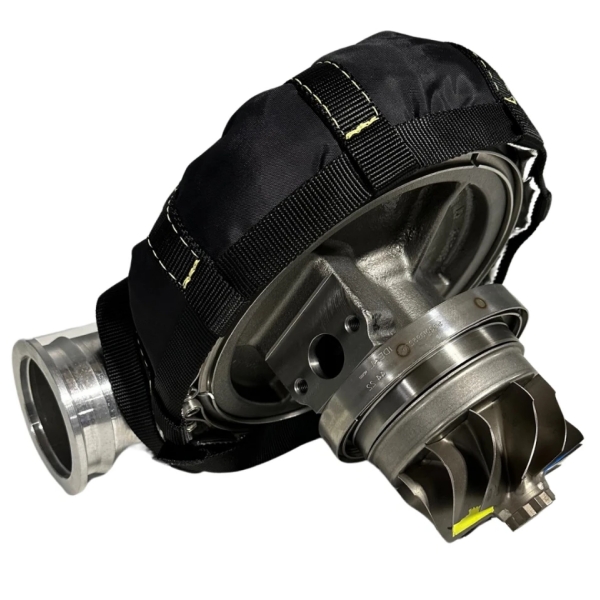
Before examining the fabric, establish why the blanket was removed. Routine turbocharger servicing, a change in compressor housing, an oil leak and a compressor failure are different situations. Record the reason rather than treating every removed blanket as a reusable spare.
Keep the product identification, installation date, previous inspection notes and any applicable review dates together. Photographs of the original installation are useful references for coverage and retention. For a used blanket with missing records, ask the manufacturer what information is needed to establish its identity and condition.
Include a blanket check in the service plan after relevant work on the turbocharger or nearby pipework. A scheduled review date is not a reason to ignore damage found earlier.
Carry out hands-on checks only after the equipment has been shut down, isolated against unintended starting and allowed to cool. Follow the supplied removal instructions. Do not cut open a blanket or unpick its seams to inspect the internal layers.
Look for cuts, punctures, worn-through areas, exposed reinforcement and local distortion. Record the location of damage in relation to the compressor housing, pipe clamps and nearby brackets. Photograph discoloration rather than deciding from color alone whether the blanket has passed or failed inspection.
When damage exposes or may extend into the reinforcing construction, keep the assembly out of service for evaluation. A clean-looking cover cannot establish the condition of hidden layers.
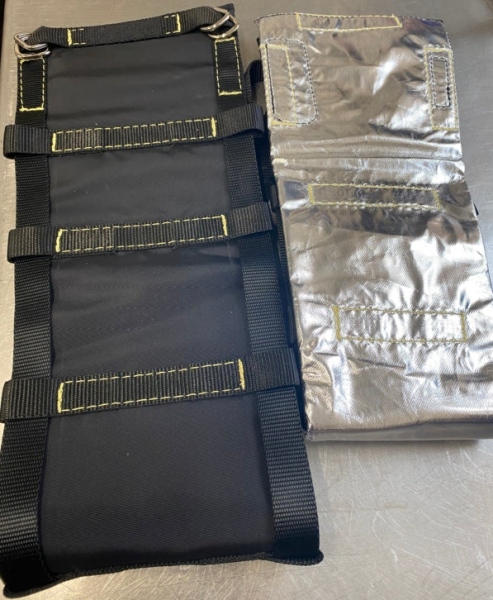
Examine the stitching around edges, closures and retention attachments. Note broken threads, opened seams, pulled attachment tabs and any evidence of previous repair. Do not dismiss damage at a fastening point as a cosmetic issue.
Compare the assembly with its original documentation. Added holes, relocated straps or a resewn closure need review; they should not be treated as equivalent to the original construction without supporting evidence.
Check the components supplied with that particular blanket. Depending on the design, these may include straps, buckles or other retention hardware. Look for cuts, deformation, missing parts and evidence that the closure has slipped.
Use the specified arrangement rather than adding improvised ties to compensate for a poor fit. Where hardware replacement is permitted, obtain the correct component and installation instructions. Replacing a fastener does not resolve damage to the surrounding attachment area.
Compare the installed position with the approved installation information. Check for movement, bunched material and new rubbing marks. Review any housing, pipework or bracket changes made since the original installation.
Do not assume that a blanket remains suitable after a compressor cover change simply because the closure can still be fastened. Confirm the required coverage and retention arrangement for the new configuration.
Record oil, fuel or chemical contamination and identify its source. Keep a contaminated blanket out of service until the leak has been corrected and the manufacturer has provided a disposition for the blanket itself.
Do not assume that solvent cleaning, pressure washing or drying restores the original condition. Obtain a permitted cleaning method for the actual materials and assembly. Report stiffening, visible heat damage or exposure outside the documented operating conditions rather than assigning an unsupported temperature rating.
A compressor failure calls for an incident review, not just a routine visual check. Keep the blanket and its retention components out of service while the failure is assessed. Record whether fragments struck the blanket and whether the housing, attachment points or nearby components moved.
Photograph the assembly before cleaning or altering it, where this can be done safely. Preserve the identification and service records. Do not reinstall it merely because no fragment passed through the visible outer cover.
Follow the manufacturer's documented process for evaluation and disposition. If the assembly is rejected, or there is no adequate basis for authorizing reuse, replace it. Do not use an engine run as a test of a questionable blanket.
A patch made from a heat-resistant fabric is not evidence that the original containment construction has been restored. The same caution applies to adhesive tape, substitute straps and locally resewn seams.
Refer proposed repairs to the original manufacturer. Ask whether repair is permitted, which procedure applies and whether additional inspection or testing is required. A replacement cover or fastening component should not be described as restoring containment performance without the relevant evidence.
For a replacement design, confirm the material construction and mounting arrangement as well as the finished dimensions. A visual match is not a performance comparison.
There is no single service-life figure that should be applied to every turbo safety blanket. Use the instructions supplied for the product and any inspection, recertification or competition requirements that apply to its intended use.
Keep scheduled review dates separate from condition-based decisions. A blanket can require attention before its next planned inspection because of damage, contamination or an incident. Conversely, an inspection date is not, by itself, a statement that every blanket must be discarded at the same age.
A useful service record identifies the blanket, the configuration, the inspection date, the findings, the action taken and the person responsible. Record the manufacturer's response when the assembly has been submitted for evaluation.
For a replacement turbo safety blanket, do not rely only on the dimensions of the old textile part. A damaged, stretched or modified blanket may no longer represent the original pattern.
Send the current compressor housing drawing or measurements, installation photographs and the reason for replacement. Include the required retention arrangement, any changes to adjacent components, the intended application and the quantity needed.
If rubbing caused the original damage, identify the contact point before approving another identical installation. If a different housing is being fitted, review the fitment as a new configuration rather than assuming the previous pattern will transfer.
BSTFLEX accepts custom turbo safety blanket inquiries for project-specific sizes and structures. For repeat orders, identify the previous order or drawing revision and state any changes. Required performance evidence and competition acceptance should be confirmed for the exact configuration before purchase.
A turbine-side insulation cover is not a substitute for a compressor containment blanket. When a project also requires heat management, review the BSTFLEX turbo heat shield blanket range as a separate part of the specification.
The existing turbo safety blanket versus turbo heat blanket comparison explains that distinction. Do not transfer the temperature rating, cleaning instructions or service interval of a thermal blanket to a containment product.
For sourcing support, send BSTFLEX your compressor housing information and blanket requirements. Include photographs of the installed position, the required quantity and any documentation needed for technical approval.
For an existing blanket from another manufacturer, obtain its service disposition from that manufacturer. A quotation for a new BSTFLEX product is a separate process; it does not approve or recertify the used assembly.
Remove it from service if there is evidence of a fragment strike, torn reinforcement, failed attachment points or damaged retention hardware. Follow the manufacturer's disposition: replace the assembly when it is rejected or when its condition cannot be adequately established.
Do not reinstall it solely because the outside looks intact. Record the failure and obtain the manufacturer's evaluation. A blanket exposed to fragment impact should remain out of service unless a documented procedure establishes that reuse is permitted.
Do not assume washing restores suitability. Identify and correct the leak, then obtain cleaning or replacement instructions for the exact blanket construction. Avoid unapproved solvents, washing methods and drying temperatures.
No single interval should be applied to every product. Use the supplied service instructions and any applicable inspection, recertification or competition requirements. Damage or an incident can require action before a scheduled inspection date.
No. Confirm the compressor housing geometry, coverage, retention arrangement and construction requirements. A distorted or previously modified blanket should not be the sole reference for a replacement pattern.
العلامات :

No.10, Chuangxin North Road, Nanshan Park, Ningguo Economic and Technological Development Zone, Ningguo City, Anhui Province, China
هاتف/Whatsapp : 0086-15856303740
البريد الإلكتروني : sales@bstbraidedsleeve.com
Skype : vanesa-cheng