عن ماذا تبحث?

The finish of an exhaust lagging installation is determined at the bends, overlaps and cut ends, not only along the straight pipe. These are the details to inspect when selecting silicone exhaust wrap for a diesel engine, generator or approved marine dry exhaust installation.
BSTFLEX Silicone Exhaust Wrap Composite Fiberglass & Silicone Lagging combines fiberglass insulation with a silicone coating. The textile provides the insulating body, while the coated surface helps contain loose fibers and provides a finished exterior. Specifying this construction requires attention to the whole assembly: insulation thickness, coating exposure, coverage and end retention.
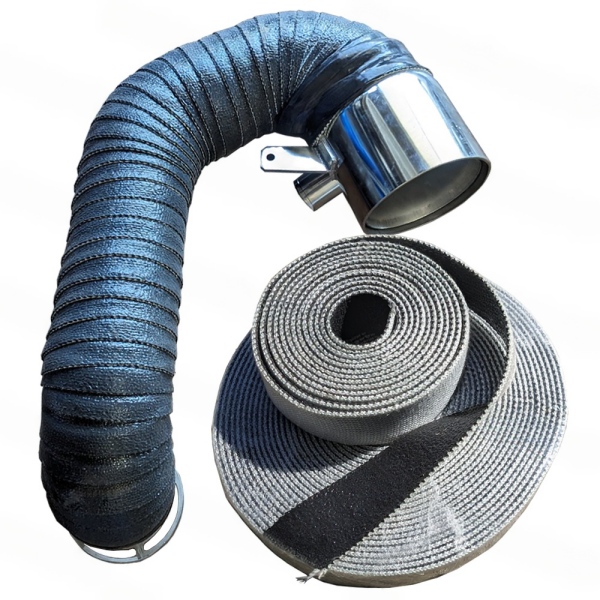
Specify the supplied form clearly. A silicone-coated composite roll is different from a liquid coating applied after a separate textile wrap has been installed. It is also different from silicone tape used for localized finishing. These products should not share one purchasing description simply because each contains silicone.
For a composite roll, identify the fiberglass construction, overall thickness, coated face and edge condition. Where an additional finishing tape is required, specify it as a separate component with its own installation and temperature requirements.
Thermal lagging is not an exhaust leak repair. End finishing contains and secures the insulation; it does not seal a cracked pipe, leaking flange or damaged exhaust connection.
The silicone fiberglass exhaust lagging product page lists the following options. Use them as a starting point for sample selection, then confirm the exact ordered configuration.
| Specification | Published options | What to confirm when ordering |
|---|---|---|
| Construction | Fiberglass insulation with silicone coating | Selected construction and coated-face orientation |
| Thickness | 2–3 mm | Required nominal thickness, tolerance and measurement method |
| Width | 25, 38, 50, 75 and 100 mm | Actual width and suitability for the tightest bend |
| Color | Red, black, silver and blue | Approved finish sample for the selected construction |
A listed range is not a dimensional tolerance. For repeat supply, agree one nominal thickness and its acceptance limits rather than ordering only “2–3 mm wrap.” Likewise, specify roll length and whether an uninterrupted piece is required for each assembly.
Keep three requirements separate: the temperature at the insulation's hot face, the allowable exposure of the silicone-coated portion, and the required temperature of the finished exterior. A material limit is not a prediction of the installed surface temperature.
For development work, provide sustained operating conditions, peak duration and the temperature-measurement location. Request limits for the complete composite and any end-finishing material. Do not transfer the rating of an uncoated fiber to the silicone layer, or use a coating rating from an unrelated product.
Where the composite is proposed over an additional insulation layer, evaluate that complete arrangement. Changing the underlying thickness, wrap tension or coverage can change the thermal result and the finished size.
The coated exterior can remain dangerously hot. Do not use appearance or touch as the acceptance test. Define the required surface-temperature target for the application and verify it under representative operating conditions. Retain required guards and clearances.
Begin the fit review at a bend, diameter transition or restricted service area. Narrower strips are worth evaluating where the wrap must change direction frequently. Wider strips are worth evaluating on larger, accessible sections where the installer can maintain consistent coverage.
For this product range, compare the 25 or 38 mm options on compact geometry and the 50, 75 or 100 mm options on larger sections as appropriate. These are trial-fit directions, not pipe-diameter-to-width rules.
Check whether the coated surface lies smoothly on both sides of the bend. Reject an installation that needs severe stretching, repeated folds or uncontrolled extra layers simply to make the chosen width fit.
Include the overlaps and end fixing when checking clearance. A sample measured flat on a bench does not represent the maximum thickness around the completed pipe.
Specify overlap as a dimension or a percentage of strip width, and explain how it is measured. A fixed overlap copied from a wider product may be unsuitable for a narrow strip.
For example, 50% of a 50 mm strip is 25 mm, while 50% of a 25 mm strip is 12.5 mm. These figures explain the notation only; they are not a recommended installation overlap. The required value must come from the approved wrap and assembly specification.
For quantity planning, record the diameter of the surface being wrapped. When the silicone composite is installed over another insulation layer, that diameter is larger than the bare pipe diameter. Using the bare pipe measurement would understate the circumference to be covered.
Use the Exhaust Wrap Calculator and Sizing Guide for initial planning inputs. Treat the estimate as a starting point and confirm actual consumption through a trial fit, including bends, transitions and finishing allowance.
Plan the start and finish positions before wrapping. An end should have enough accessible surface for its specified retention method, while leaving clamps, flanges, sensors and inspection points serviceable.
The BSTFLEX product description identifies silicone end tape as a finishing option. Confirm the appropriate tape for the supplied composite rather than assuming any self-adhesive or self-fusing silicone tape is interchangeable.
Ask how the finishing material bonds, how much overlap or tension it requires and what temperature it can tolerate at the termination. Follow the specified retention arrangement; a neat-looking taped end is not, by itself, proof of secure fastening.
Include the cut edge in sample approval. Check for projecting fibers, lifting coating and loose material after fitting. The objective is a controlled, durable termination, not an unsupported promise that every edge is completely sealed.
Do not use a new coated layer to conceal an unknown insulation condition. Before proposing an overlay, identify the existing material and check the pipe and insulation for damage, contamination and moisture. Unknown legacy insulation should be assessed before it is disturbed.
An overlay should be considered only where the existing layer is identified, sound, dry and accepted for continued use. Include its thickness and condition in the specification, then assess the combined installation for temperature, clearance, retention and inspection access.
Replace unsuitable underlying material rather than enclosing it. Where frequent access to the pipe is necessary, evaluate a removable arrangement instead of building up successive wrap layers.
For diesel exhaust lagging, identify the proposed coverage on a drawing or photograph. State whether the section is an ordinary pipe run, part of a service joint or adjacent to an aftertreatment assembly. Do not extend insulation across a component merely because it is connected to the same exhaust.
For a marine installation, distinguish dry metal pipework from water-jacketed components and downstream wet exhaust hose. They are different parts of the system and should not receive one blanket wrapping instruction. The dry portion of an otherwise wet exhaust also needs to be identified separately.
Evaluate marine dry exhaust wrap only for sections where the exhaust designer permits the proposed insulation. Preserve water-injection arrangements, cooling functions and access to connections. Lagging does not replace a failed cooling system or repair a damaged wet exhaust hose.
For generator exhaust lagging, include sustained-load operation and enclosure conditions in the evaluation. A brief idle demonstration is not enough to approve a configuration intended for extended duty.
Coverage: Photograph the tightest bend, an overlap and both terminations. Confirm that the required surface is covered without obstructing movement or service access.
Thermal result: Record the operating condition, stabilization period and measurement locations. Check the finished surface and the nearby components that the installation is intended to protect.
Condition after cooling: Inspect for coating damage, edge lifting, displaced overlaps and loose retention. Agree whether the application requires further thermal cycling or environmental evaluation.
Maintenance: Decide how the installation will be checked for deterioration or contamination in service. A coated surface is not proof that the underlying pipe is free from corrosion or that the assembled wrap is watertight.
For a quotation, provide the selected width, nominal thickness, finish and required usable length. Add the pipe dimensions, operating conditions and any underlying insulation. Identify the required end tape or fixing hardware separately so the complete configuration can be reviewed.
For OEM or distribution orders, include quantity by size and the proposed packaging. The existing OEM and private label exhaust wrap supply guide covers sample approval and packaging requirements. Keep the installation specification with the approved sample for repeat orders.
No. The composite is supplied as a fiberglass-based wrap with a silicone coating. A spray is a separately applied surface treatment. Their construction, installation and operating limits must be specified separately.
No. Finished surface temperature depends on the complete insulation arrangement and operating conditions. Specify and verify the required result rather than treating nominal thickness as a safety guarantee.
Do not assume so. Agree an overlap dimension or percentage for the selected strip and installation. Confirm the result on bends and at transitions before finalizing roll consumption.
No. In this application, it is an insulation-finishing component, not a pipe or flange repair. Correct exhaust defects before installing thermal protection.
Only after the existing material and its condition have been assessed and the complete overlay arrangement approved. Do not cover wet, contaminated, deteriorated or unidentified insulation.
Use BSTFLEX Silicone Exhaust Wrap Composite as the product reference and send your dimensions, operating conditions and end-finishing requirements. For comparison with other constructions, review the Exhaust and Header Heat Wrap range, or request a quotation for your exhaust lagging project.

No.10, Chuangxin North Road, Nanshan Park, Ningguo Economic and Technological Development Zone, Ningguo City, Anhui Province, China
هاتف/Whatsapp : 0086-15856303740
البريد الإلكتروني : sales@bstbraidedsleeve.com
Skype : vanesa-cheng